FOOD
Pavarotti Pasta Recipe by Bellino Spaghetti alla Luciano
PAVAROTTI PASTA
Recipe :
1 medium Onion, peeled and sliced
2 j- 32 oz. jars of Italian Tomato Passata (we like Mutti)
3 cloves Garlic, peeled and chopped
2 tbsp. Tomato Paste
1/4 cup red wine
1/4 cup chopped Italian Parsley
1/2 cup grated Parmesan or Romano cheese
1/2 teaspoon Red Pepper Flakes
1 pound of imported Italian Spaghetti (best quality)
Anthony Bourdain Favourite Secret Restaurant in Rome – Lunch with Asia Argento – Settimio al Pelligrino – Roma
Anthony Bourdain with Asia Argento
A Meal at Settemio
Rome, Italy
TONY’S SECRET RESTAURANT – Rome
On Sunday December 5, CNN broadcast a stunning Rome episode of Parts Unknown in which Anthony Bourdain and Asia Argento go to a trattoria, which they do not name. It’s Settimio. Sorry for the spoiler but I don’t believe in depriving Mario and Teresa of business through exclusion Watch the episode it is brilliant.
I vividly remember my first visit to Settimio al Pellegrino. It was in 2007 and my friend Jess and I had gotten a hot tip from a regular that a short walk from Campo de’ Fiori sat an uber-authentic trattoria serving simply dressed fresh pastas, meaty mains, and seasonal vegetables. We made a booking but when we showed up for dinner the door was locked. We were already off to a rough start. One of us noticed a button next to the door and after a sustained buzz, chef and owner Teresa opened the door a crack and said something to the effect of “chi siete”, who are you?
If that doesn’t sound like a warm greeting, it wasn’t. But at Settimio, warmth isn’t doled out frivolously. Warmth is earned. If you turn up without a reservation, there’s a real chance you will be sent away, whether they are booked up or not. It’s the kind of place where the possibility of a regular rolling in late leads Teresa and her husband Mario to set aside tables for such an occurrence. And even calling to reserve well in advance doesn’t guarantee a table. On that note, if you don’t speak Italian, have your hotel ring for you. And if all this sounds too fussy, don’t read on. Settimio isn’t for you.
TONY’S SECRET ROMAN TRATTORIA – ROME
The trattoria is SETTINIO PELLIGRINO. I’m not letting Tony’s secret out of the bag. That happened years ago, Just passing on the information for anyone who wants to go there, and need the name of the restaurant and address (Via del Pelligrino 17 -Roma .. tel 06 6880 1978).
ANTHONY BOURDAIN
PARTS UNKOWN – ROME
I have to be honest: arbitrary seating policies give me agita. I grew up in restaurants and treasure hospitality. I want to connect with the people who make and serve my food, not be rejected or dismissed. Yet I was determined to win over Teresa and Mario. That night, Jess and I ordered every course, including my current go-to, polpette, scorched yet delicious meat patties. We cleaned our plates, admired the eclectic decor (framed posters and paintings gifted by Settimio’s clients, which include plenty of artists and film makers) and watched as Mario worked the room, taking orders and doting on regulars. Teresa emerged from the kitchen occasionally to clear plates and pinch cheeks. Man, did it feel bad being an outsider at Settimio that night.
Jess and I apparently didn’t make much of an impression because I went back on my own a few days later for lunch and was given the same suspicious treatment. After a few more visits, however, I was totally in, cheek caresses and all. This is good news if you live in Rome or visit often. You, too, can become a doted-on regular. Otherwise, visit knowing you won’t be pampered by the service but you’ll definitely walk away having witnessed a Roman relic.
That is to say, a lot of what’s appealing about Settimio is the attitude and atmosphere. Some regulars have been going since the place opened in the 1930s, others a decidedly shorter length, but all are given special attention. In that way, the place is not unique. The attraction to countless other local joints is the experience and the relationship with the owners, even more so than the food.
I don’t think anyone with Roman dining experience would say the food is flawless. Like many places in town, it makes sense to stick to certain things like those meatballs or the onion-rich vitello alla genovese. At Settimio, comfort food reigns: fettucine with meat sauce, gnocchi with tomato sauce (Thursdays only), trippa alla romana, and involtini (meat rolls). The handmade pastas pass muster, but you won’t write home about them. The pillowy, super sweet, candied chestnut-studded Montblanc, which they do not make in house, is another story. I dream about it sometimes. Usually right before I go to the dentist. I am also very into the mela cotta (baked apple). I’m a sucker for overcooked fruit.
Second only to the struggle of winning the owners’ affection is the wines, which range from undrinkable to painfully undrinkable. While it’s charming that regulars leave unfinished bottles in the fridge for their next visit, I can honestly say that the only wine worse than the wine at Settimio is day-old wine at Settimio. It’s not what you’ve come for anyway.
Settimio al Pellegrino
Via del Pellegrino, 117
+390668801978
Dive Bars of New York
.
New York and the $3.00 PBR, Pabst Blue Ribbon Beer has been a God-Send to many New Yorkers. As you all know, the US Economy has been in the Shitter for the past 5 years or so.
It’s not OK, what’s a person to do? So yes, we live in New York, and having a couple cocktails here can be a costly undertaking.. What is a Poor Working Guy or Working Girl to do??? Well Boys and Girls, let’s Thank God for that great thing of wonder and the Bars and establishments who so graciously and kindly serve it, The $3.00 PBR, That’s right, a $3.oo Beer in The Land of The Over-Priced $16.00 Cocktail, Manhattan, New York, NY….. It’s quite Sad, Greedy too, not to mention “Ridiculous Ludicrous and Insane.”
Daniel Bellino Zwicke
Copyright 2008
PLACES To GET A $3.00 PBR in NEW YORK
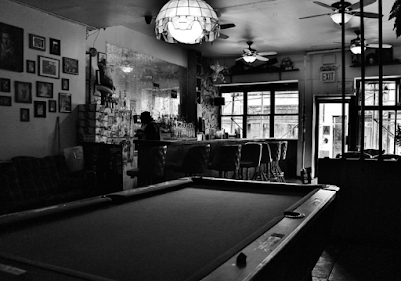
BLUE & GOLD BAR in the East Village, on East 7th Street between 1st and 2nd Avenues. Blue & Gold has long been a favorite of mine ever since I lived in the East Village from 1982 to 1994. It’s just a cool ol normal old style bar with a pool table, standard 50’s 60’s Bar Decor, and Best-of-All $3.oo PBR’S and $6.00 Cocktails. I love it.
The HORSESHOE BAR
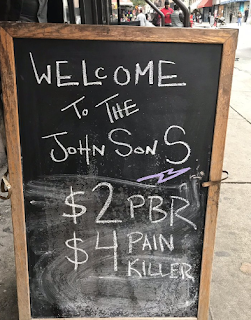
7B a.k.a. The Horseshoe Bar, also in the East Village, a bastion of cheap and fare prices in Manhattan and Land of The $3.00 PBR (now $4 in 2023) and other $3 and $4 Beers. 7B is located on the corner of Avenue B at 7th Street ..
And SECRET RECIPES
Lucy’s Bar is the most aptly named bar in New York. For Lucy—the quiet and small and sweetly proper Polish owner with the well-coifed gray hair and floral blouses—is who you’ll see when you go there, and Lucy is the one who will serve you. If there are other employees, they’ve hidden themselves somewhere in the back.
Though Lucy’s is undeniably a dive (and one of the last in the neighborhood), it feels more like your aunt’s aging rec room, a place where you’d never think of disrespecting the house’s hospitality. It’s also one of the last vestiges of the Polish community that was once made up a significant part of the East Village’s character.
Ludwika “Lucy” Mickevicius moved from Poland to New York in the late 1970s and soon got a job at Blanche’s, a bar on St. Mark’s Place run by another Polish woman. She became such a fixture that people began to think of the bar as Lucy’s, and, when Blanche retired, she sold the place—by then located on Avenue A—to her bartender.
Lucy’s life doesn’t range much further than the twin poles of her joint and Poland, which she visits regularly, shutting up the tavern at a moment’s notice and disappearing for weeks at a time. Most nights, she stations herself at the far end of the bar near the ancient cash register. (It’s cash only here.) One recent evening, the Halloween balloons hadn’t yet been taken down. Then again, assorted Thanksgiving and Christmas decorations were already out. Maybe none of the decorations are ever packed up?
Lucy doesn’t budge much behind the bar, but she keeps herself busy for a woman in her mid-70s. She will draw you a pint or a glass of tequila. And, if she likes you, she might pour you a shot of żubrówka, a Polish bison grass vodka, on the house. When the place gets stuffy, she’ll swing open the door to let some fresh Avenue A air in; just as quickly, she’ll close it if it gets chilly.
The clientele ranges from a less-intense sort of downtown hipster, who exchange a few friendly words with Lucy—who, even all these years later, still speaks in broken, accented English—and then retire to their personal conversations, to old Polish regulars. In fact, on another recent night, a young couple came in to show Lucy their young child. All four spoke entirely in Polish and a delighted Lucy let the little scamp climb atop the pool table. As they left, she handed the kid one of the old Halloween balloons. For those few minutes, Lucy’s was a family bar.
GOT ANY KAHLUA ?
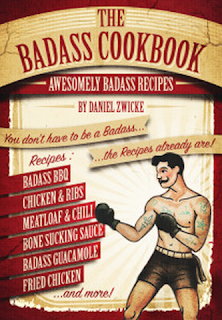
The BIG LEBOWSKI COOKBOOK
Daniel Zwicke
Lower East Side
If Clockwork’s happy hour special seems too good to be true, you’ve got a little good old fashioned neighborhood competition to thank. Located right around the corner, 169 has been in operation since 1916. And its 11:30am-7:30pm HH is among the best in the city. $3 will get you an “Old Man Can/Bottle” of beer (PBR, Carling Black Label, Schaefer, Genesee Cream, High Life/Miller Lite) and any well shot. Subtly New Orleanian environs (window shutters look like they’re fresh off a Creole cottage; beads are strung here and there; there’s crawfish on the menu) evoke genuine good times.
.
Remembering Josh – Josh Ozersky
REMEMBERING JOSH
Joshua Ozersky (August 22, 1967 – May 4, 2015) was an American food writer and historian. He first came to prominence as a founding editor of New York Magazine’s food blog, Grub Street, for which he received a James Beard Foundation Award (with co-editor Daniel Maurer) in 2008. He was the author of several books, including The Hamburger: A History – Colonel Sanders and the American Dream, and Archie Bunker’s America: TV in an Era of Change, 1968–1978 . He was Editor-at-Large for Esquire, writing about food and restaurants. He also wrote frequently for The Wall Street Journal, Food & Wine, and The New York Observer, among other places. Although read primarily as a food writer, he has said in numerous public appearances that he disliked “food writing” as such, and that his strongest influences were G. K. Chesterton, Thomas Babington Macaulay and A. J. Liebling.
Ozersky was born in Miami in 1967. He moved to Atlantic City, New Jersey, in 1979 when his father, the painter David Ozersky, got a job as a stage technician in the first of the area’s casino-hotels, Resorts International. He attended Atlantic City High School and Rutgers University. His mother, Anita Ozersky, died suddenly when he was 14 years of age. Of his interest in food, he has said in interviews, “I was a friendless child, and a solitary and celibate teenager … my father and I only spoke about movies and food, and food far more than movies. He was a great gastronome and taught me to self-medicate my loneliness with steaks and sausages.”[4] He later attended New York University‘s School of Journalism and started work towards a doctoral degree at the University of Notre Dame, where he eventually received a master’s degree in American history.
After graduating from Rutgers University in 1989, Ozersky wrote for several publications on media and cultural history topics, most frequently in Tikkun. The first articles he was paid to write appeared in a short-lived satirical weekly called “The Hoboken Review,” based in Hoboken, NJ, where Ozersky lived at the time.[7] Among his earliest works for The Hoboken Review was an article titled, “I like it greasy,” in which he celebrates his disdain for overly-health-conscious eating—a recurring theme in his future food writing. From 1990 to 1993 he wrote two weekly columns for the West Side Spirit, a free weekly newspaper in New York City: a semi-humorous “TV Picks” column and a cheap-eats column called “The Impoverished Gourmand” under the name “Casper Gutman.” Many consider this guise, which was loosely based on the character from The Maltese Falcon, as a forerunner of “Mr. Cutlets,” his later fictive persona. In the mid-1990s, he wrote for Suck.com under the name “The Boob”, as well as for Newsday, where he frequently contributed essays on culture and media. His book “Archie Bunker’s America: TV in an Era of Change” a cultural history of television programming, received a disappointing critical reception. Although his ambition at this time was to establish himself as a public intellectual after the example of his mentors, Neil Postman and Mark Crispin Miller, he eventually turned to food writing full-time with the publication of his 2003 book “Meat Me in Manhattan” 2008’s “The Hamburger: A History” was a critical success, receiving positive reviews in publications on both sides of the Atlantic, including The Economist, The Times, The Observer and Forbes.
Subsequent to “Meat Me in Manhattan”‘s publication, Ozersky was a contributing restaurant critic for Newsday (2004–2006), and wrote regularly for the website Slashfood and the New York Law Journal. He became the founding editor of New York Magazine food blog Grub Street,[13] a position he held until 2008, when he moved over to Citysearch as National Restaurant Editor. There he ran a daily food blog based on the model of Grub Street called The Feedbag, along with his regular Citysearch duties.[14] He left in 2009 to start Ozersky.TV, a venture with Eater founder Ben Leventhal, featuring short films about restaurants and cooking, which debuted in July 2010. He wrote the “Taste of America” column for Time from 2010 to 2012. Both Ozersky TV, “Taste of America,” and his work in The Wall Street Journal was nominated for James Beard Awards. Essays by Ozersky were also included in “The Best Food Writing” anthologies of 2009, 2012 and 2014.
In 2010, Ozersky was criticized by Robert Sietsema Writing about his wedding in Time without disclosing that the chefs who participated donated the food as wedding gifts. Ozersky defended himself, saying that the chefs involved were among his closest friends, and that the most prominent of them, Michael White, had his daughter in the wedding party as a flower girl.
Ozersky was found and pronounced dead in his Conrad Chicago hotel room on May 4, 2015, while in the city for the James Beard Foundation Awards. Officials said the autopsy reveals he died after suffering a seizure in the hotel shower and drowned.
Ozersky was the founder of Meatopia, a large meat-centric outdoor culinary event, which has been held in New York City for the past ten years. In 2013 Meatopia events were held in London, England and San Antonio, Texas, with more cities planned for 2014. Meatopia held a very small event in 2013 in New York City while focusing the majority of its efforts on the London and Texas events. Each year has had a different theme such as “Slaughter of the Innocent” (baby animals); “Lamb Bam Thank You M’aam” (whole lambs); “City Meat,” (NYC 2012) in which the festival was divided up into multiple “neighborhoods” such as Offalwood, Carcass Hill, and Beaktown; and most recently (NYC 2014) The Carnivore’s Ball, a celebration of the 10th annual Meatopia which was hosted by Michael Symon. Meatopia has been called “a glorious city of meat” by The Huffington Post[ and “a bacchanal of pork, beef, lamb, chicken, duck, turkey and quail” by The New York Times.
JOSH
Josh Ozersky was one of the Great Food Writers of All-Time. He had a style of writing and chatting on food, that was all his own. There was no-one quite like Josh. The closest to this Giant of Food Writing and pontificating would be the late great Anthony Bourdain. Another Giant. These two men were a great gift to The Food World and its millions of fans. And they both left us far too soon, and millions mourn them.
Josh was not nearly as well know and popular as Anthony, but he was certainly his equal. They both had their own styles, which were both absolutely wonderful, yet different. Hey, they were wo different human beings.
When Josh passed away, he was only 47 years old. Anthony Bourdain was 61 when he passed. It was a tremendous loss and the World Mourned. Tony had millions of fans. The world still mourns Bourdain’s passing, and pine for him. Sadly these two giants of human beings (food writers / hosts) are sorely missed, and will always be remembered.
RIP
HAMBURGER TRIBUTE to JOSH
Remembering Arthur Frommer – Budget Travel Guides
Arthur Frommer, known for the guidebook Europe on 5 Dollars a Day and other titles on budget travel, has died aged 95.
Pauline Frommer, his daughter, confirmed his death in a statement on his website.
The writer, who began his journalism while on military deployments abroad, passed away at home surrounded by his loved ones.
“Throughout his remarkable life, Arthur Frommer democratised travel, showing average Americans how anyone can afford to travel widely and better understand the world,” Pauline wrote in her statement.
“I am honoured to carry on his work of sharing the world with you, which I proudly do with his team of extraordinary and dedicated travel journalists around the world. We will all miss him greatly,” she added.
Frommer was the founder of Frommer’s guidebooks – a series of travel books that included planning and travel tips to destinations around the globe.
The series was based on Europe on 5 Dollars a Day – one of his first publications, which came out in 1957 and sold millions of copies.
The book detailed how average Americans could afford to take trips that many thought were only accessible to the wealthy.
“This is a book for American tourists who a) own no oil wells in Texas, b) are unrelated to the Aga Khan, c) have never struck it rich in Las Vegas and who still want to enjoy a wonderful European vacation,” he wrote in the original guidebook.
Frommer was drafted during the Korean War. He was sent to Europe and served in Germany because of his language skills. While deployed, he wrote what would be his first travel guidebook for his fellow service members, The GI’s Guide to Travelling in Europe.
As well as a writer, Frommer was a TV and radio host whose work helped shape others’ approach to travel.
In one essay, Frommer wrote that travel “broadens our lives”.
“Travel has taught me that despite all the exotic differences in dress and language, of political and religious beliefs, that all the world’s people are essentially alike,” he wrote. “We all have the same urges and concerns, we all yearn for the same goals.”
I was 22 years old when I made my first trip to Europe. I book a flight on PanAm from JFK New York to Rome. It was $55o. I can’t tell you how excited I was on the flight over, and those first 5 days spent in Rome, and I was in total euphoria as I explored The Eternal City. I just couldn’t believe it. I was like a young child on Christmas Day. That’s the feeling I had, super excited and oh so happy. And again, I was in a state of euphoria. That’s how much I loved it.
Pizza Night in Jersey – 60s New Jersey
My first memories of PIZZA were from Bella Pizza in East Rutherford, New Jersey. I was a young boy and this Pizzeria just opened on Park Avenue. It was a standard Pizzeria like many others found all over the New York-New Jersey metro area, serving solid pizza just the way the locals like it. The pizza was of a high standard as all the pizza must be if you’re going to make and sell Pizza in the heavily Italian-Populated New York and New Jersey areas. A large pie which you just ordered as a Pizza, the one that is known as Pizza Margherita in Italy is made of the pizza dough topped with tomato sauce, Mozzarella Cheese, salt, pepper, and a little olive oil. Basta!
The Pizza in America are much larger than those made in Italy and are cut into 8 triangular slices and are enough for 2 or 3 people to eat, or even four if you’re not that hungry or sharing a Pizza just as a snack in-between meals. I can still remember the price of the pizza at Bella Pizza in East Rutherford back in the 60s a whole pie cost just $1.50 and a slice was .20 cents. So if you wanted what they call in Napoli and all over Italy the Pizza Margherita, you just simply ordered a Pizza, or a Cheese Pie, or simply a Pie, meaning it was with Tomato, Mozzarella , and Basil and no other toppings. And if you wanted extra toppings, you just say a Pepperoni Pie, or half mushroom half pepperoni, or a Sausage Pie or whatever. That’s the way it was and more or less still is with ordering Pizza at your standard pizzeria. Nowadays most pizza cost between $2.25 and $2.75 a slice and about $16.00 to $20 and even more for a whole plain pie.
Anyway, as most kids did and do, we loved eating pizza, and on most Friday nights it was Pizza Night for many families in Jersey. Mom didn’t want to cook that night, the kids loved getting pizza and looked forward to it as a special treat on Friday nights, as we knew it as Pizza Night and we just loved it. We’d have pizza, Coca-Cola and some sort of sweets, a cake or Ice Cream for desserts after we ate our Pizza. Yes Friday Night Pizza was always a much loved treat as a child growing up in Jersey in the 1960s and 70s. We’d listen to WABC Radio and Top 20 Hits, R&B, and Rock-N-Roll and all was fine in the World, we had all that we needed. How I miss those sweet days of youth and a simpler time than today. Back then you had everything you needed in life. We had Radio and TV and we still do today. We had Cars that were beautiful unlike some of the ugly ones of today. We had the Telephone, no cel phones or internet, we didn’t need them. We all had a Football, a Basketball, a Baseball Bat, Baseball, and Glove to play Baseball, Basketball, and Football as all healthy American boys did back then. We didn’t have Video Games but we had Aurora Racing Car sets, maybe Electric Trains, and wonderful Board Games like; Monopoly, Candyland, Chess, Checkers, Stratego, and Battle Ship. And one of the most wonderful things we had back then in the 60s & 70s was great music unlike the Crap they call music today, we had Great Top 100 Hits, wonderful R&B sounds of Motown and The Philly Sound, we had The Beatles, The Rolling Stones, and Rock-N-Roll, what do the kids have for music today? Sadly, just Crap Rap and the other garbage they think is music. Yes it’s quite sad what has happened to music in the past 20 years. But yes we had everything we needed; Radio, TV, cars, a stereo, Sports, great music to listen to, and Pizza, we always had Pizza, we still do.
Well sorry, I got off topic, but it’s all part of the story you see. In Italy when it comes to Pizza it’s a bit different than the way Pizza is done in America. Pizza was born in Napoli where it is revered into a high religion and is to made just so. The Pizza is much smaller and is made for one and they do not make slices unless you are in Rome or other parts of Italy where they make Pizza that is made in large pans ahead of time and then cut into squares and heated up when a customer orders some. That’s Pizza Taglio, and most Pizza made in Italy is Neapolitan Pizza that is made to order. As we’ve said they are individual sized (about 12” round) for one person and made to order and are cooked in hot wood burning ovens to strict standardized specifications. A Pizza Margherita made in the true Neapolitan fashion is made with fresh tomato puree, olive oil, salt, fresh garlic, basil, and mozzarella placed on top, then the pizza cooks in the hot wood burning oven, and is ready in just about 4-5 minutes. Pizza Margherita was created by Raffaella Esposito in 1889 where he was working at Pizzeria di Pietro. He made the Pizza and named it in honor of Queen Margherita of Savoy who was visiting Naples (Napoli) at the time. American Pizza on the other hand is made with a cooked sauce and we tend to put more sauce and cheese than they do in Italy .
Now, my own experience eating Pizza in Italy. Well the first pizza I first had in Italy was Pizza Taglio (pan Pizza) and not the Classic Neapolitan Pizza, which is by far the dominant pizza in all Italy, and though there is Pizza Taglio which is sold in square slices, it’s a mere fraction as far as its presence goes, which is just about 1% of all Pizza consumed in Italy is Pizza Taglio, the rest being classic Neapolitan. Anyway, there’s very good pizzeria that makes Pan Pizza close to the train station in Rome. Like other pizzerias that make Pizza Taglio in Italy, there’s an array of different pizzas with different toppings that are already made and are laid out before you. You choose which type of pizza you’d like, tell them the size you want, they cut it and weight it to determine the price by weigh.
Yes the pizza is a bit different in America, but it’s dammed good, and America makes the world’s best pizza outside of Italy. And as far as Pizza goes in America, everyone knows that the best Pizza in the country is made in New York, and especially in Brooklyn with great shrines to Pizza in the form of; Tottono’s in Coney Island, Grimaldi’s, and DiFara Pizza by Pizza Maestro Dom DeMarco. Then you’ve got John’s on Bleecker Street in Greenwich Village and the first Pizzeria ever to exist in the United States Lombardi’s on Prince Street, established in 1905.
Anyway, enough with the technicalities of Pizza, sometimes things are analyzed too much, just eat it and enjoy. We loved eating Pizza on Pizza Night or any time of the week when we were lucky enough to get it. And there is one particular time that I always remember. We went on a trip with our local church to the big beautiful Riverside Cathedral in New York one time, and it was a very special trip. When we came home, the Priest and other church officials made a little Pizza Party for us in the church basement. They ordered a bunch of Pizzas for all the kids (Grownups too) and it was a very special thing for us, as pizza always was and even so to this day. Yes there’s nothing like when you’re a child and they have a Pizza Party for you, we just loved it. And so these are my memories of Pizza.
Excerpted From “MANGIA ITALIANO” Memories of Italian Food
by Daniel Bellino-Zwicke
What The Presidents Ate – Favorite Presidential Food The United States of America
So began one of the strangest partnerships in United States history. As Hemings apprenticed under master French chefs, Jefferson studied the cultivation of French crops (especially grapes for wine-making) so they might be replicated in American agriculture. The two men returned home with such marvels as pasta, French fries, Champagne, macaroni and cheese, Creme Brûlée, and a host of other treats. This narrative history tells the story of their remarkable adventure—and even includes a few of their favorite recipes!
PRESIDENT ANDREW JACKSON – 7th AMERICAN PRESIDENT
FRIED CHICKEN
HAMBURGERS
The Worlds Best Tacos – Burritos Taco Stand Taqueria Mexico City
Taqueria El CALIFA De LEON
MEXICO CITY
TACOS El CALIFA De LEON
- Tacos El Califa de León, a taco stand in Mexico City, won a Michelin star
- Its famous tortillas cost nearly $5 and go best with a Coke, according to the chef
- Michelin-star chef Arturo Rivera Martínez said the honor was ‘neat’ and ‘cool’
Mexico City’s Tacos El Califa de León has received a Michelin star, making it the only taco stand in the world to receive the coveted award from the French dining guide.
Not making a big fuss of the incredible honor, the tiny restaurant’s main chef, Arturo Rivera Martínez, stood over his grill Wednesday searing meat for a horde of hungry customers as he’s done for 20 years.
Asked how he felt about receiving the Michelin star Rivera Martínez said ‘está chido … está padre,’ meaning:’It’s neat, it’s cool.’
Although Michelin representatives came Wednesday to present him with his well-deserved full-sleeved white chef’s jacket, he didn’t put it on. Not out of disrespect, but simply because his cooking area is tiny – 10 feet by 10 feet – and extremely hot.
Diners at the stand can only order tacos, and the meat inside comes from either a cow’s rib, loin or fore shank.
The prices at the taco stand, however, are a lot more affordable with a huge taco costing nearly $5. Customers say the tacos there are the best, if not the cheapest, in the city.
El Califa de León has been around since 1968 and has been doing the same things that’s made it so successful since the beginning.
Thousands of times a day, Rivera Martínez grabs a fresh, thinly sliced fillet of beef from a stack and slaps it on the 680 degree steel grill.
He then dashes a pinch of salt over the meat and squeezes half a lime on top before grabbing a soft piece of freshly rolled tortilla dough to heat it up on the grill.
Less than a minute later – he didn’t share exactly how long because ‘that’s a secret’ – he flips the beef, flips the tortilla and assembles it on the plate for the waiting customer.
Good Times at Milano’s – New Yorks Famous Dive Bar